Flow Is Just Play Remembering What It Is

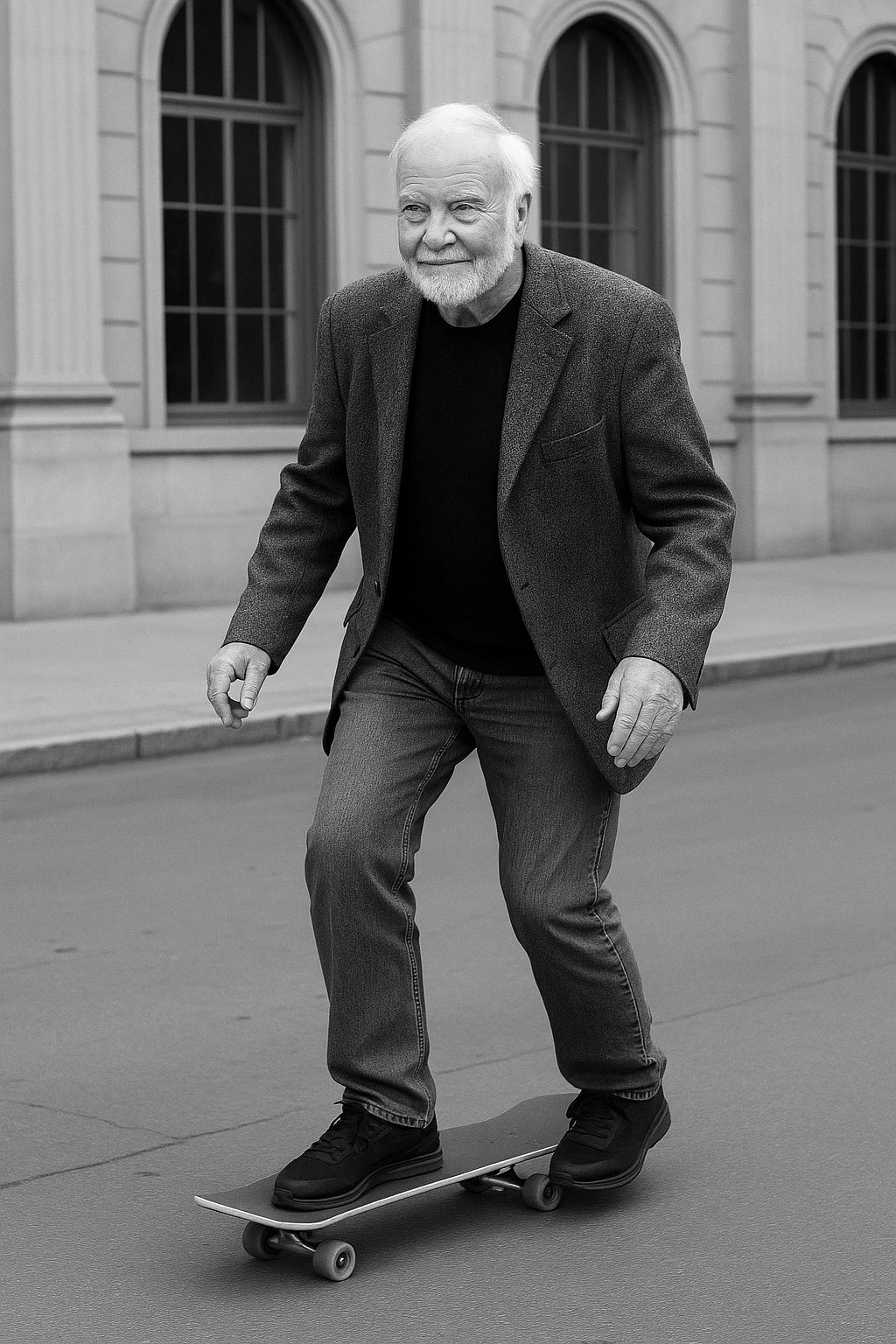
There’s a moment — maybe you’ve felt it — when the body stops asking for permission. The chatter fades, your internal scorekeeper clocks out, and something quieter, older, and far more competent takes the wheel. You’re paddling into a wave or carving down a slope or hitting that perfect rep you didn’t think you had. Time loosens. The world sharpens. You’re no longer performing or trying. You’re playing.
That moment? Mihaly Csikszentmihalyi — pronounced cheek-sent-me-high, yes really — the psychologist who first mapped this territory, called it flow.
The term has been overused and repackaged into wellness-speak and corporate workshops, but its original spirit is far more primal. Flow isn’t a hack for productivity. It isn’t about squeezing more output from the same exhausted psyche. Flow is the nervous system returning to its birthright — a state of absorbed, embodied aliveness where self-consciousness dissolves.
Flow is play with adult stakes.
Flow is the human animal remembering itself.
The Science of What the Body Already Knows
Csikszentmihalyi spent his career tracking the thread of effortless concentration across wildly different groups: climbers, surgeons, dancers, monastics, musicians, surfers, chess masters. He found eight consistent markers of flow:
- A challenge that matches your skill.
- Full concentration.
- Clear goals.
- Immediate feedback.
- Loss of self-consciousness.
- A sense of control.
- Altered time perception.
- Autotelic experience — the activity is its own reward.
Translated into HippieJock:
Flow is what happens when the moment demands everything you have,
so the parts of you that ruin it — worry, ego, overthinking — fall away.
That’s the common thread: when your attention locks into the present and the brain’s inner narrator shuts up, something deeper and more fluid emerges. Call it instinct. Call it presence. Call it the unconscious. Call it the body’s wisdom. Whatever it is, it knows what to do.
And that’s exactly what we used to access all the time as kids.
Flow is the Adult Version of Losing Track of Dinner Time
Kids don’t talk about “flow.” They don’t need the vocabulary. They just feel it. Watch any child in a tree, on a bike, running through a field, or inventing some ridiculous game with a stick — and you’re watching flow in its purest form.
Total commitment.
Total joy.
Time distortion.
No self-consciousness.
No scoreboard.
Complete absorption.
That’s flow.
The adult mind complicates everything. We pile on goals, expectations, fears, performance standards, productivity obsessions, and other forms of psychic armor. We stop playing because we fear looking foolish. We fear being bad at something. We fear wasting time.
This is how aliveness drains out of adulthood.
Flow is what happens when we re-enter the state we never should have abandoned: play.
Play isn’t childish. Play is essential. Flow is simply play with experience behind it. Play is flow without the language for it.
Both are the nervous system’s natural setting — the factory default.
When Flow Happens, the Mind Isn’t Empty — It’s Finally Quiet
Phil Jackson’s great line — “When the mind is still, the magic flows” — isn’t mystical fluff. It’s neuroscience.
In flow:
- the prefrontal cortex (the part that narrates and worries) downshifts
- implicit memory (the body’s stored skills) takes over
- motor coordination and perception sync tightly
- time-processing networks loosen
- dopamine and endorphins rise
- the brain stops second-guessing and starts doing
It’s not “no mind.” It’s “no interference.”
Flow is not the absence of thought; it’s the disappearance of unnecessary thought. What remains is a streamlined mind-body channel: perception → action → correction → perception, without mental static.
This is why movement is the easiest route. The body is always present. The mind is the one that wanders. When the body’s demands exceed the mind’s capacity to chatter, flow emerges naturally.
Movement Opens the Door. Play Walks You Through It.
Surfing. Snowboarding. Lifting. Trail running. Rowing. Skating. Climbing. Paddling. Slacklining. Even a well-tuned hike.
These aren’t hobbies. They’re portals.
They demand just enough from the body and mind to pull you into that razor-thin space between effort and ease. You can’t ruminate when your attention has a job. You can’t catastrophize when your balance matters. You can’t obsess about tomorrow when the moment has teeth.
Movement tricks you into presence, and presence is the entry point to flow.
Play takes it one step further. Play wipes out the agenda.
When you’re playing, you’re not optimizing, achieving, or proving. You’re not trying to extract value from the moment. You’re inhabiting it.
Adults often only experience play as “vacation mode,” but the truth is more radical: play is a biological necessity. It’s how the organism resets, imagines, explores, adapts, and heals.
Flow is play when the skill level rises, when the stakes increase, when your embodied intelligence starts to surface and take command. It’s not childish; it’s deeply adult. It’s what happens when the body matures but the spirit keeps moving.
Flow Is a Spiritual Form of Attention — Even If You Hate That Word
You don’t need religion to feel it, but flow has always had a spiritual flavor. When the ego dissolves and the body-mind system unifies, there’s a sense of rightness, of clarity, of being exactly where you’re supposed to be.
Flow is not escapism. Flow is contact.
Contact with the moment. Contact with your breath. Contact with reality. Contact with the part of you that’s more animal than anxiety.
This is why flow feels sacred. It’s not supernatural — it’s super-natural. That is: more natural than the anxious, fragmented, overworked state most modern adults live in.
Flow is the return. Play is the gateway.
The HippieJock Bottom Line
Flow isn’t reserved for elite athletes or enlightened monks. It’s available to anyone with a moving body and a willingness to let go of self-consciousness long enough to be absorbed.
Play is the simplest way back into yourself. Movement is the language. Flow is the experience. Stoke is the afterglow.
The world tells adults to be serious. Your nervous system is begging you to play.
Flow is just your body remembering how to say: “This is what I’m made for.”